How do you take the luxury experience your business creates and translate that into photos for your website? A strong website tells your brand story from multiple perspectives, and photos are a HUGE piece of that storytelling. In today’s world, AI websites are popping up all over the place — a website could get filled with infinite content, and visitors are reading between the lines, trying to decipher what the actual, in-person experience of the business will be. Website photos are SO important for building this human connection and trust. As the saying goes, a picture is worth a thousand words.

Four types of photos for your website
First up, let’s discuss the different categories of photos you can include on your site. Whether you’re planning a brand photoshoot, or sifting through years’ worth of images, you need to keep the end result in mind: a collection of images that tell your story from multiple angles. We want to keep website visitors engaged — if you feature the same sort of photo over and over, people will start to loose interest.
01 Portfolio or Product Photos
What type of work do you want to be known for? About 60% of the photos on your website should feature your work and/or your product. These photos speak to exactly the type of work you do. They showcase your talent and style to your audience.
For luxury service-providers, photo selection is a tool to help you attract more of the clients you want to be working with. For example, if you’re a wedding planner looking to do more luxury destination weddings, make sure your website features your best destination work right on the homepage. Potential clients are going to scan your photos before forming an impression of you, so the right selection is key to drawing them in.
But what about service-providers without a portfolio, like CPAs, medical professionals, or lawyers? The same principle still applies! Your site should features photos of the exact type of work you do. Let’s say you take a relationship-based approach. Instead of just a series of headshots on your site (or worse, stock images that look like they’re from the 90’s), include a variety of images, like meeting with a client, a zoom-in of your hand pointing something out, and shots of your office space. How much better does that feel?!
Play with scale
Beyond subject matter, scale is another tool to curating an engaging variety of photos for your website.
Detail shots are photos that are up-close and personal with your product or service, and they are so important to your website. We’re all about the details (that’s part of our job as designers!). Those tiny details and unique moments that your audience may not notice otherwise are what make your product or service a luxury experience, so make sure they’re highlighted in the photos on your website.
Details, check. You’ll also want to go in the opposite direction and zoom out for those scroll-stopping wow moments. Drone photography is becoming more common in industries like construction and events, but it can even be as simple as a wide shot of your office to contextualize the details and headshots featured on your website.
Let’s say your a luxury interior designer curating images for a case study. Instead of just throwing the entire gallery on the page and calling it a day, wouldn’t a narrower selection that actually tells the story of the project be so much more compelling? Imagine a drone shot of the property to get the context, different wide-angles of the room to orient visitors to the space, and detail shots to show off the luxury design elements. Mixing these all together creates a much more engaging user experience.
Show your brand in context
It’s not enough to simply show your product or service in isolation. Make sure you’re including images that show how the people actually interact with your work. We cannot stress this enough! For example…
If you're a boutique hotel, don't just show off the rooms, show the little moments your guests will enjoy about your stay. Those unique moments will help them imagine themselves in your hotel. Once they have that image in their mind, it builds your memorability.
If you're selling a high-end candle, don't just show the product photo, show it lit next to a cozy couch or inviting bubble bath. Place the product in a space that aligns with your brand image. Your audience is going to envision that candle in their own space.
If you're a wedding vendor, don't just show the shots of the reception tablescape, show your couple (and their guests) experiencing their dream wedding day design!
02 | Process
What does your process look like? 30% of your photos should show the magic behind your work. Will your audience still have questions about your process? Of course. But these photos give them a little behind the scenes and spark their interest to want to learn more about your process.
Luxury means high touch, impeccable craftsmanship, and well-considered details. Process photos are the perfect way to help share the value of your brand. This could look like…
If you’re a wedding planner, a shot of you adjusting a tablescape or fixing a bride’s dress right before the ceremony.
If you’re selling handcrafted goods, showing off your studio and artisans at work.
If you’re in construction or interiors, showing blueprints and materials swatches.
03 | Portraits
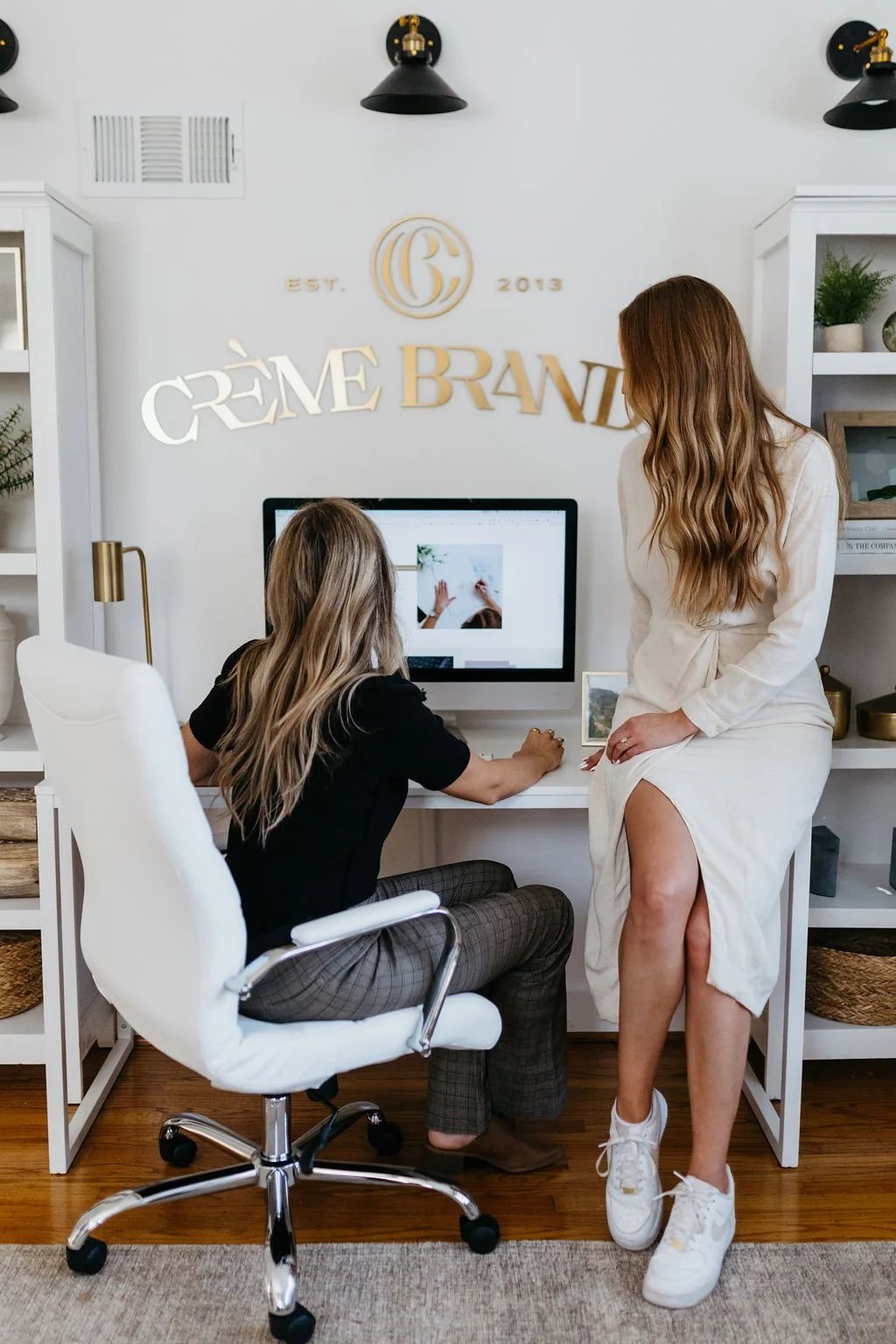
Who are the faces behind your brand? About 10% of your photos should feature you and your team. Including photos of your team (along with some fun facts) adds a sense of personability. It puts people behind your brand, and helps your audience get to know who your brand is, what your team brings to the table, and how you all collaborate together. Teamwork makes the dream work, so why not showcase that teamwork in action!
With the proliferation of AI-generated websites, it can be really hard to tell if a business is legit or not. Even if a website copy makes it seem like there’s a big team behind the operation, website visitors will be skeptical until they can trust that the business is actually out of the “fake it ‘till you make it” phase. Photos of your team at work are a powerful way to build this trust.
How to curate the best photos for your website
Alright, your gears are spinning on the types of photos your website should feature, but what if you have hundreds of images from years’ worth of work?! Where to even start with narrowing it down? Let’s discuss some tips for a way to curate your images that’s much more streamlined, and much less overwhelming.
Compile a “favorites” folder
First, get general! No need to make a ton of cuts off the bat or preselect images for each landing page right away – that can make the process feel a bit overwhelming. With so many photos to choose from, you’ll want your favorites all in one simple spot. Create a folder for all your website images, throw all your contender in, and then narrow it down from there. We recommend aiming for around 100 of your favorite images total. That number gives you a broad selection without feeling too overwhelming.
Check image resolution
Good image quality is a non-negotiable. If a photo on your website look pixelated or even a tiny bit low resolution, your business immediately looks less polished, so this is especially necessary for luxury businesses. Your website designer will optimize your photos for you (i.e., make the file size smaller so your site runs faster), so you want to start with the highest-resolution version of each photo you have. Eliminate anything that looks low resolution to your eye or can’t be zoomed into without getting pixelated right away. A good rule of thumb is to send your website designer images that are 1 MB or larger and they’ll optimize them for you.
Choose photos that are on-brand
If you’ve done professional branding, pull up the moodboard your designer created for you and test your photos next to that. Eliminate any that are clashing or just give a completely opposite vibe. When the color palette of your branding and photos are working in harmony, your entire website feels more elevated.
Look for variety in, well, a variety of ways
As your editing your image library down, make sure you’re including a variety of images. As discussed before, a mix of zoomed-in and zoomed-out shots will keep things engaging. You’ll also want a mix of aspect ratios (horizontal and vertical) to work with a variety of layouts. You’ll need to showcase your business in a straightforward way, i.e., standalone product shots or polished portfolio images, but also in-use and in context.
A note on portfolio curation
If you have a portfolio, take the time to curate it thoughtfully too. Don’t sell your work short and leave it as an afterthought! We recommend no more than 25 images per gallery to keep visitors engaged. When deciding on which case studies to include, show a variety of styles so all diffferent types of clients can see themselves represented.
At the end of the day, make sure you choose website photos that build a sense of emotion. The more imagination and inspiration you can spark, the more you can capture your audience’s attention and help your brand stick in their memory. Remember, a picture is worth a thousand words, so use your website photos to your advantage. They tell your brand story in a way far more impactful than words alone.